
A walking pad usually brings a low-profile moving belt into a room that already has another purpose. A treadmill often adds an upright console, handrails and a wider range of operating speeds. Those descriptions are useful starting points, but product names overlap. Some folding treadmills also work in a walking mode with the handlebar lowered. Some walking pads offer incline. A machine described as “2-in-1” needs a closer look at what the two modes actually allow.
The practical choice is about the relationship between the equipment and your day. Will you use it at a desk, in front of a screen or for a separate training session? Does it stay in place, or will you move it after every use? Is automatic incline important, or would you rather have a longer belt? Answering those questions first makes the specification table much easier to read.
Start with the routine, not the model name.
Walking while doing something else
If the idea is to add walking to desk time, begin with your working position. The desk must allow enough height for you to stand on the machine and use your keyboard or other equipment comfortably. Its legs and crossbars must leave room for the treadmill body, your feet and your normal movement. A photograph of a compact machine under a desk does not establish that it fits your particular furniture.
Look for the permitted speed and handlebar position for desk use in the exact model's instructions. A machine's highest advertised speed may apply only with the upright raised. Keep any required stop control within reach, and do not cover the controls with the desk. The first question is whether the setup allows you to use the machine as instructed. The question of how long you would like to walk comes after that.
A separate walking or jogging session
For a dedicated session, the upright console, belt dimensions and reachable controls become more prominent. You may want to change speed without looking for a remote, keep a water bottle nearby or follow a program on your own device. Check where those items sit and whether they obscure the display. A tablet holder is helpful only if the device fits securely without blocking something you need to see.
Do not choose a maximum speed simply because it is the highest number in a comparison. Consider the pace you expect to use and the usable belt area at that pace. The CURSOR FITNESS SF60 reaches 7.2 mph and has a 38.2 × 15.2-inch belt. The 20% incline treadmill reaches 8.7 mph and has a 42.5 × 16.2-inch belt. Those differences answer separate questions about speed and available surface.
A routine you will actually repeat
Think through an ordinary weekday rather than an ideal training day. Where will the equipment begin? What needs to move before you can use it? How many adjustments will you make, and where will the remote, shoes or manual be kept? A setup that requires shifting several heavy pieces of furniture may be less convenient than its folded dimensions suggest.
Write down the steps between deciding to use the machine and being ready to start. Then write down the steps after finishing. This small exercise often reveals the most useful buying criterion. It could be a single folding knob, a manageable route to storage or a dedicated corner where the bike can remain assembled. Convenience is a property of the whole setup, not only of the machine.
Measure the whole setup.
Separate the belt from the frame
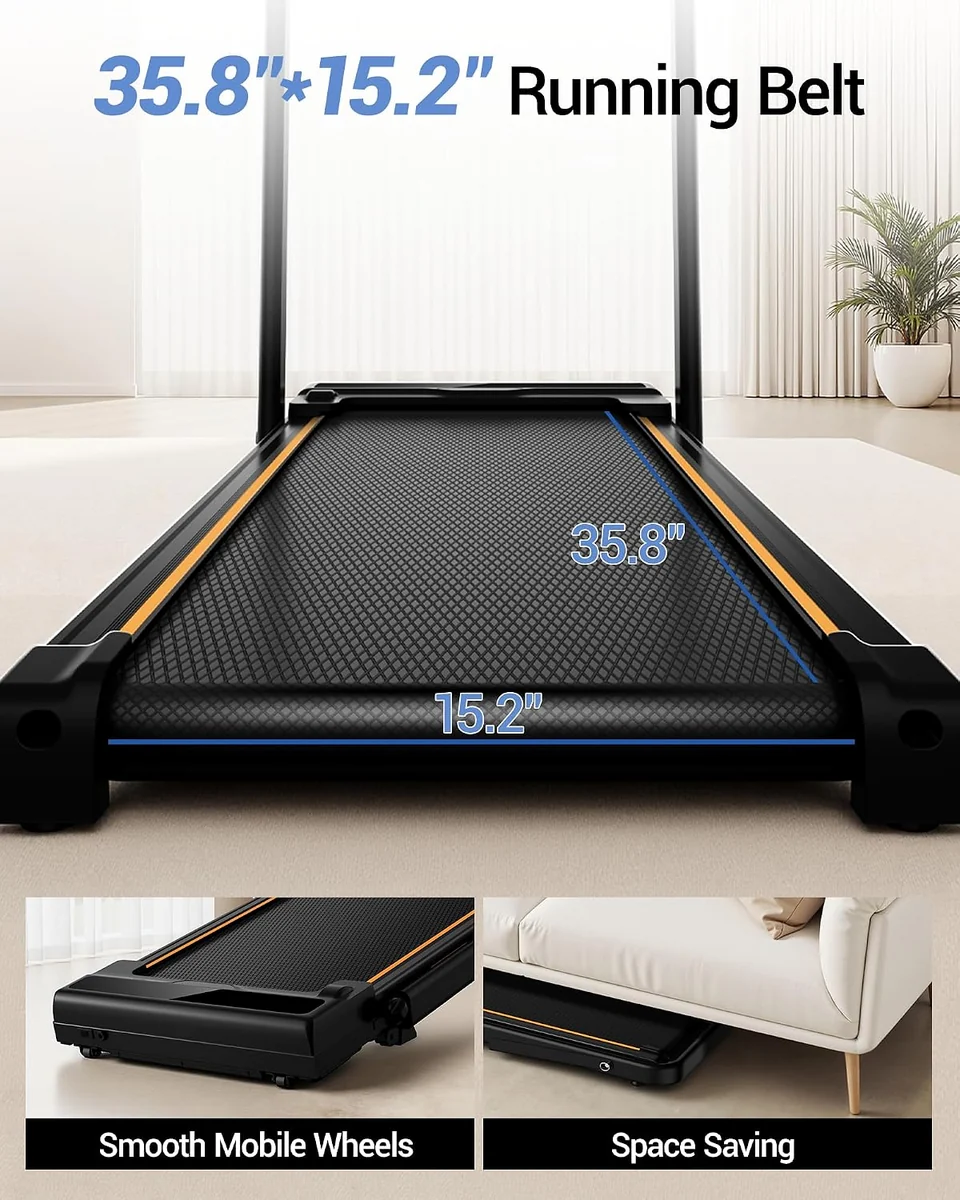
The running-belt measurement describes the surface on which you move. The overall dimensions describe the frame around it. Neither should be substituted for the other. A narrow frame may still have side rails, a motor housing or a rear section that extends beyond the usable belt. Compare the two sets of dimensions when marking out a space on your floor.
Use removable tape to outline the outer footprint, then mark the belt within it if you have the measurements. This does not simulate walking on the machine, but it makes the proportions easier to understand. Notice nearby doors, furniture corners and anything that could obstruct the required clear area. Follow the clearance distances in the exact model's manual. There is no single safe spacing figure that should be copied onto every treadmill.
Check storage in three dimensions
A folded height is only one measurement. A treadmill that fits beneath a bed may still be too long for the opening or too wide to slide past a support. Measure the usable storage space from the floor to the lowest obstruction, not to the top of the furniture. Include the route needed to move the machine into position without tilting it in a way the instructions prohibit.
The SF60 is listed at 44.8 × 23.5 × 5.4 inches when folded. Those three numbers work together. The 5.4-inch figure alone cannot tell you whether it fits under a particular sofa. Compare folding methods too: lowering an upright is different from folding the running deck itself. Two machines with similar folded heights can require very different lengths of storage space.
Walk the route between use and storage
Transport wheels make certain movements easier, but they do not remove the equipment's weight. Look at doorway widths, thresholds, floor changes and the turn needed to reach your storage space. Consider whether you will have to lift the machine, and follow the handling instructions rather than assuming it can be pulled by any convenient part.
A route across one level room is different from moving between floors. If the machine will live upstairs, check the delivery and assembly arrangements before ordering. Measure the actual path, including corners, rather than comparing only a doorway with the product width. For a heavy station such as the 160 lb home gym, plan the installation location first; it is intended to remain assembled rather than move in and out of storage every day.
Think vertically as well as horizontally
Your feet will be above floor level on a treadmill. Incline can raise part of the deck further. A room with a low ceiling, a sloping roof or a hanging light needs attention to the full operating position, including the person using the machine. Do not estimate this from a product photograph. Use the model's dimensions and placement instructions and check the actual room.
The same idea applies under a desk. Pedal height and knee movement matter when using a seated elliptical, while your standing position matters on a walking pad. A low-profile machine is not automatically a comfortable workstation. Chair height, desk underside and the range of movement all contribute to the result. Test the relevant seating or standing position before deciding that an available patch of floor is enough.
Compare the controls and the incline.
Manual and automatic incline are different jobs
Manual incline is set by physically repositioning supports or another mechanism. Automatic incline uses controls to change the grade. If you want to vary the slope during a session, that distinction matters more than the largest incline number printed on the product image. Read how the model makes the adjustment and when the instructions permit it.
In this collection, the SF60 has automatic incline up to 15%. The X5F and the 20% incline treadmill use manual settings. The latter offers three positions: 2%, 16% and 20%. It should not be described as an automatic treadmill merely because it has a touch console. Likewise, automatic speed control on another machine does not establish automatic incline. Identify the function being automated rather than relying on the word alone.
Keep percentages, degrees and levels separate
Incline may be described as a percentage, an angle in degrees or a number of adjustment levels. These are not interchangeable labels. Six levels means there are six settings; it does not mean the highest setting is 6%. A value expressed in degrees should not be copied into a percentage column without a clear, correct conversion.
Our equipment comparison preserves the units used by the named models. The SF60 and UREVO Strol 2S Pro publish percentage figures, while Sunny's SF-T722876 lists a range in degrees along with six automatic levels. The table also shows belt size and top speed because a single incline figure cannot describe the full tradeoff. A longer belt, lower storage profile or preferred adjustment method may matter more in your room.
Make sure you can reach what you need
Picture yourself using the machine with the upright in the position required for your session. Locate the start, stop and adjustment controls. If the model uses a remote, decide where it will sit when you are not holding it. If a safety key is supplied, follow the exact instructions for using it rather than leaving it as an unused accessory.
Displays and device holders deserve the same practical check. A screen may show several metrics at once, but those figures still need to be visible from your position. A tablet can make a session more engaging while also covering a control or reading. Check the layout with the device size you own. Pictured tablets, phones and laptops usually demonstrate a use case; do not assume they are part of the included equipment.
Read motor and noise claims in context
An advertised horsepower figure is a product specification, not a complete measure of performance across every user and session. Compare it alongside the stated operating range, user limit, belt dimensions and instructions. Do not assume that a larger headline number alone makes a treadmill the better match for a particular person.
Sound claims also need context. The machine, your movement, the floor and the room can all contribute to what is heard. Without comparable test conditions, a pair of published decibel numbers does not establish how two products will sound in your home. Check floor placement and any recommended protective surface in the manual. Treat absolute promises such as “silent in every apartment” with more caution than a practical explanation of the drive and setup.
Consider whether a belt is the right answer.
An upright exercise bike
If you prefer pedaling to walking, start with the riding position and adjustability. An upright exercise bike has a saddle and handlebar relationship that needs to suit the rider. Check how the seat moves, how the handlebar adjusts and how each setting locks. The correct setup is more useful than selecting a bike solely by the number of resistance levels.
The CBE10 Magnetic Black Orange variant uses magnetic resistance and a belt drive. Other products with a similar CBE10 name use friction resistance. Match the exact configuration in the purchase tab rather than assuming every image or specification under the family name applies to every option. The mechanism, equipment weight and overall dimensions can differ between variants.
A recumbent bike or seated elliptical
A recumbent exercise bike places a backrest behind the seat and the pedals ahead. That creates a different position from an upright saddle. Compare seat adjustment, pedal reach and access around the frame. The 16-level recumbent model here needs a 47.08 × 26.18-inch footprint before adding the clearances in its instructions.
A small C2 under-desk elliptical serves another purpose again. It moves your feet while you remain in a separate chair. It is for seated use, not for standing on the pedals. Check chair stability, knee clearance and the full path of the pedals. Choose between these options by the activity and position you want, not by assuming every compact cardio machine performs the same task.
Plan for the part after buying.
Match the exact product and seller
Before paying, compare the model name, variant and key dimensions with the item you researched. Similar photographs can hide different versions. Color names can also identify more than a cosmetic change. Keep the resistance type or incline mechanism in view if that was central to your decision.
Check the current price, delivery estimate, seller and return terms in the purchase tab. A checked price on a guide is not a guarantee that the offer remains unchanged. Save the confirmation and keep the model details with it. If you later need a manual, a part or support, those records help identify the equipment accurately. A generic brand name alone may not be enough to find the correct instructions.
Allow time for assembly and checks
“Partly assembled” does not mean ready for every kind of use immediately out of the box. Read the supplied setup sequence, identify the included parts and complete the checks the manufacturer specifies. Keep packaging until you have inspected the delivery and understand any applicable return conditions.
Place tools and small parts where they will not be lost, and use the model's instructions for tightening and adjustment. If a part is missing or the equipment is damaged, contact the seller through your order before improvising a substitute. A treadmill, a magnetic bike and a hydraulic trainer have different setup requirements. Advice for one should not be transferred automatically to another just because the brand is the same.
Keep maintenance model-specific
A belt, cable, resistance system or folding joint may need attention over time. Follow the schedule and methods in the exact manual. Do not apply an online lubrication recipe, adjustment sequence or replacement part to a different model without confirmation. Even two treadmills can use different procedures.
Store the manual and order information somewhere easy to find. If the equipment behaves unexpectedly, stop using it and follow the shutdown instructions. Record any error message and the conditions in which it appeared before contacting the seller. Clear observations are more useful than guessing at a cause. Our Help page explains what to have ready for a support request.
Build a shortlist you can explain.
Choose two or three candidates and write one sentence about why each fits your routine. For example: “I want automatic incline and can accommodate the SF60's folded footprint.” Or: “I prefer an upright ride and want the magnetic CBE10 variant.” If the reason is only that a product has the biggest number, go back to the way you plan to use it.
Then check the measurements in your own room, the operating mode you expect to use and the exact selected configuration. Read the purchase terms before ordering. The goal is not to find a machine that wins every possible comparison. It is to choose equipment whose purpose, fit and everyday handling make sense together in your home.
Your final room check
- Operating footprint and clearances from the exact manual.
- Usable belt size or comfortable pedal reach.
- Storage length, width and height, plus the route to reach it.
- Reachable controls in your chosen operating mode.
- Exact variant, current offer, seller and support terms.
Further product information
For the model examples discussed here, see the UREVO Strol 2S Pro specifications, Sunny SF-T722876 specifications and the WalkingPad equipment FAQ. Always use the manual supplied with your own model for placement, operation and maintenance.